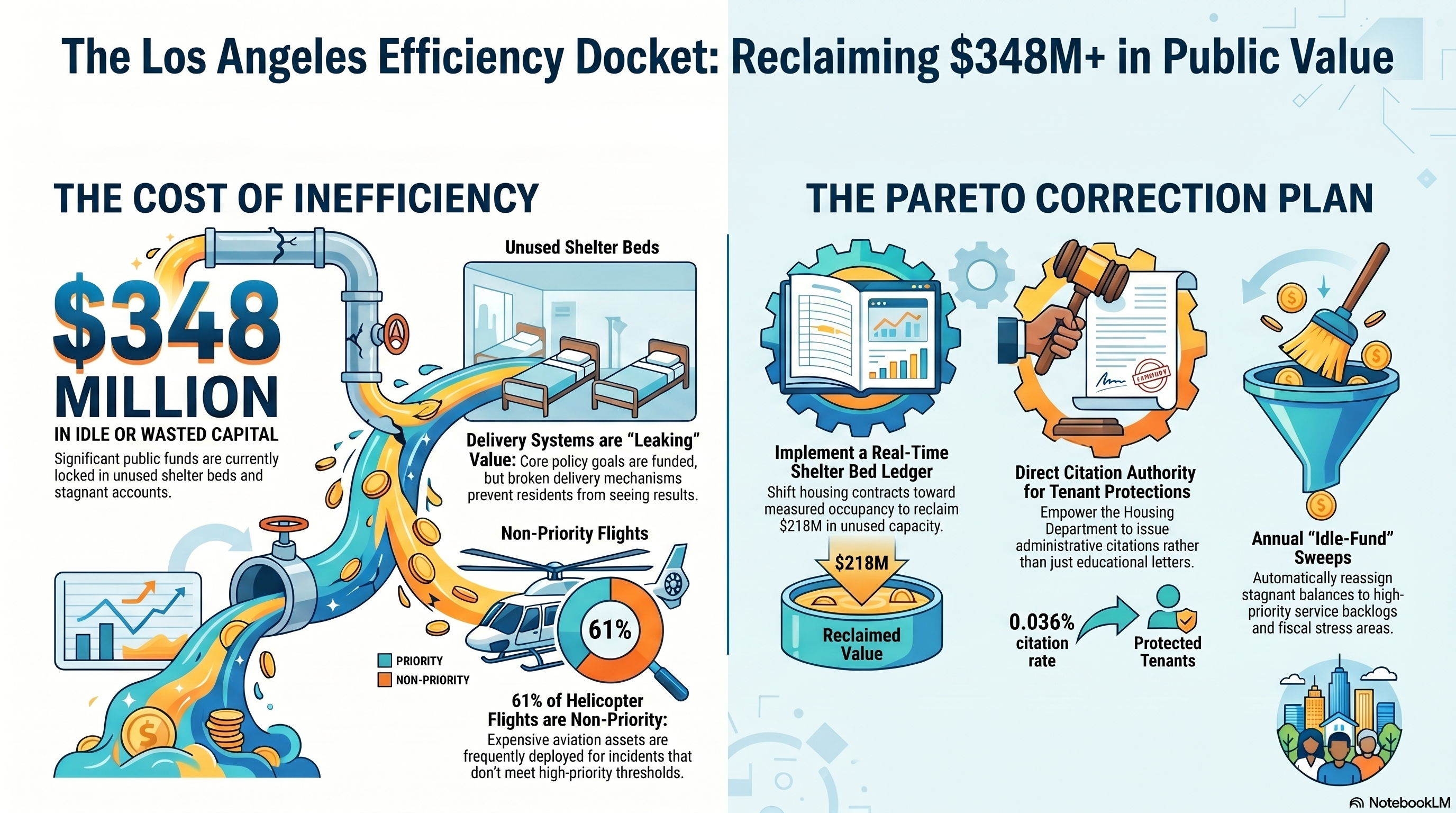
NotebookLM overview, generated from this policy study
policy study - city of Los Angeles - 2026
Pareto-inefficiency candidates in Los Angeles city programs
This study identifies city policies and programs where the public record suggests a
redesign could improve outcomes without increasing total public cost. In strict
economic terms, true Pareto inefficiency is hard to prove in municipal government;
the working standard here is narrower and auditable: wasted capacity, weak
enforcement, idle money, or high-cost deployment that can be reallocated without
cutting the service goal.
8priority candidates
$348M+identified cost or idle-capital surface
4immediate audit-to-action items
headline finding
The largest inefficiencies are coordination failures, not exotic policy failures.
The clearest cases share a pattern: the City already pays for a policy goal, but the
delivery system leaks value before residents see results. Beds are funded but unused.
Tenant protections exist but rarely become enforcement. Money is legally available but
idle. Aviation assets fly many lower-priority missions while cheaper alternatives remain
under-tested.
triage map
Public value at stake vs. ease of correction
graphic indicators
What the public record already quantifies
Unused interim bed cost218$M
Idle funds identified80$M
Annual helicopter cost50$M
TAHO complaints referred0.2%
TAHO citations issued0.036%
Percent bars for TAHO are intentionally tiny: they show how rarely complaints moved into
stronger enforcement paths, not how important the policy is.
enforcement funnel
Tenant Anti-Harassment Ordinance implementation
11,000+complaints submitted
23referred for stronger enforcement consideration
4citations issued
program map
Priority candidates
01
Interim housing bed system
LAHSA / City-funded providers
audit priority96
$218Mestimated cost of unused interim beds, FY2019-FY2023
why it matters
Publicly funded shelter capacity sat unused while people seeking beds could not reliably secure placement.
pareto-style correction
Create one real-time bed ledger, publish data quality rules, and shift contracts toward measured occupancy and permanent-housing outcomes.
Publish an efficiency docket.
City Council should maintain a public docket of programs where audits identify idle money,
unused capacity, weak enforcement, or high-cost deployment misalignment.
Require owner departments to answer with numbers.
Each department should report the current baseline, the intervention it will test, the
metric that will improve, and the date by which the public can verify the change.
Move dollars only after process fixes are defined.
Reallocation should not become a blunt cut. The goal is to preserve or improve the
public purpose while removing the leakage mechanism.
Repeat quarterly.
Pareto-style improvements are best treated as a recurring budget discipline, not a
one-time report.