platform · interactive
Thermodynamics
Heat, work, and the slow drift toward equilibrium — explored through dynamic simulations, the four laws, and the everyday idioms we use to talk about energy without realizing it.
Temperature is motion
What you feel as "hot" is the average kinetic energy of countless tiny collisions. Slow the particles and the thermometer falls. Speed them up and the walls feel the push.
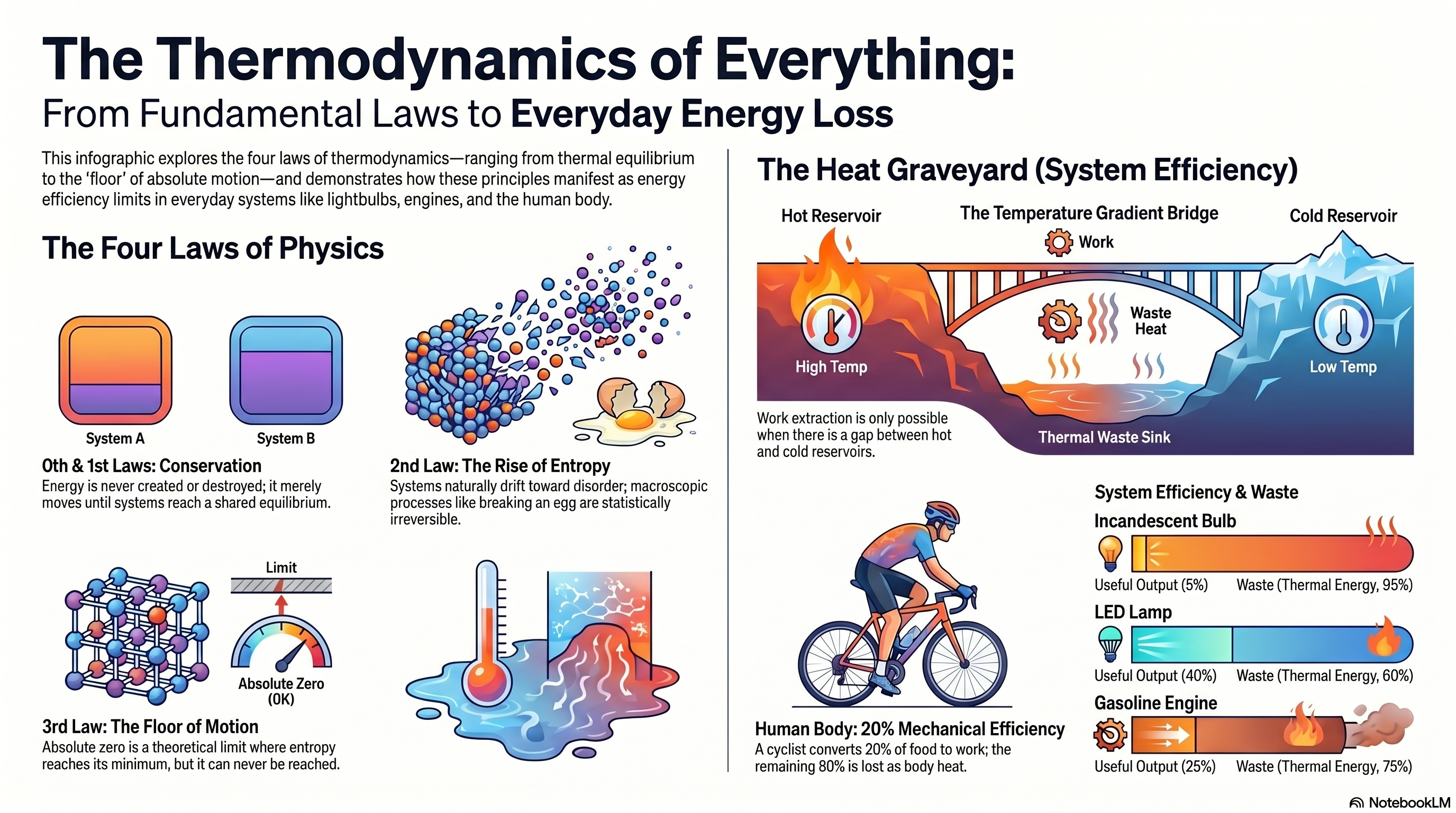
Zeroth law — thermal equilibrium
Put a hot body next to a cold one and connect them. Energy walks the bridge until both sides agree on temperature. Two things in equilibrium with a third are in equilibrium with each other — the rule the other laws lean on.
First law — energy is conserved
ΔU = Q − W. The internal energy of a system rises when you pump heat in and falls when it does work on the world. Push the piston down and the gas heats up; let it expand and it cools as it lifts the weight.
Second law — entropy only rises
Open the partition between a full chamber and an empty one. The gas spreads. It never gathers itself back. Entropy counts the ways a state can be arranged, and the universe picks the bigger pile every single time.
S(t) — Shannon entropy of left/right occupancy
Third law — the floor of motion
As temperature approaches zero, the entropy of a perfect crystal approaches a fixed minimum. You can chase it asymptotically — each step takes more work than the last — but you can't quite touch it. Motion never fully stops.
The heat engine
The Carnot cycle is the upper bound on what any engine can do with two thermal reservoirs. Two isotherms, two adiabats. Efficiency depends only on the temperature gap. η = 1 − Tc/Th.
The cup of coffee
Hot things lose heat at a rate proportional to how far above their surroundings they sit. dT/dt = −k(T − T∞). Exponential — fast at first, then patient.
The speed distribution
Even at a single temperature, particles don't all move at the same speed. The Maxwell-Boltzmann distribution describes the spread — a long tail of fast outliers, a population clustered near the most probable speed.
Idioms of heat
Everyday English is full of thermodynamics. We talk about energy, gradients, and irreversibility without naming them. Each card connects a phrase to the physics it secretly cites.
Where energy goes
Energy is conserved but it isn't kept. It cascades through usable forms toward heat at ambient temperature — the graveyard of every joule. Each row shows a transformation and the inefficiency hidden inside it.