↗ open full size
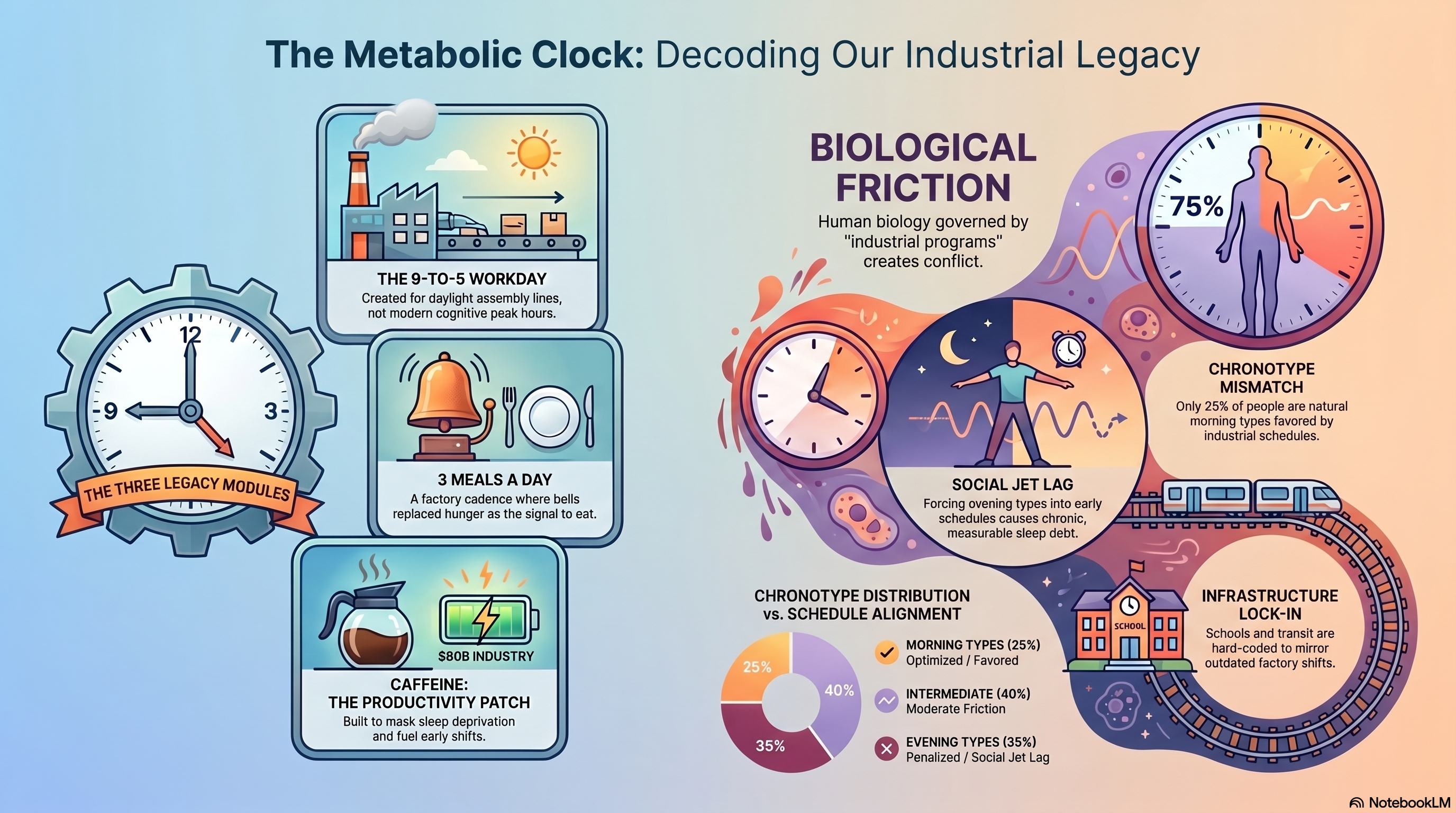
Visual summary of the argument — the three legacy modules and the biological friction they
create. Generated with NotebookLM from this page.
gilded age legacy project · industrial time as legacy code
the metabolic clock
The industrial capture of human biology — meals, caffeine, and the colonization of time.
The Gilded Age and the Industrial Revolution did not only leave physical infrastructure —
railroads, factories, steel mills. They left biological and cultural infrastructure
embedded in our bodies and our schedules. The three-meal day, caffeine dependence, the
9-to-5, the five-day week, and retirement at 65 are legacy code running on outdated
hardware: industrial programs executing on post-industrial humans.
3meals a day — a factory cadence, not a biological clock
1926Ford standardizes the five-day week
30–40%of humans are genetically evening chronotypes
8 hrworkday — built for daylight and the assembly line
thesis
Industrial time as legacy code.
The question is not whether these patterns are natural — they are not. It is whether we
have the collective will to debug the system and write new code aligned with human biology
rather than factory output. This page reads five inherited modules — meals, caffeine, the
workday, the week, and chronotype — as a single business model designed to synchronize
bodies for mechanized production, and asks what it would take to deprecate it.
the metabolic clock
A 24-hour factory schedule, mapped onto the body
Illustrative, not measured. The clock face shows how the industrial program slices a
24-hour body: a continuous 9-to-5 work arc, three synchronized meals, a caffeine patch to
mask the morning, and sleep compressed at the top of the dial — where the 2–3 PM slump is
the body’s circadian reality that the schedule overrides.
legacy modules
Five inherited programs — origin logic vs modern residue
three meals a day
metabolic
industrial logic
Factory bells replaced hunger as the eating signal. Breakfast fuelled the 5–6 AM shift, a precisely timed lunch interrupted the line midday, and dinner became restitution after industrial depletion. The cadence was synchronized so production never stopped.
modern residue
“Breakfast is the most important meal” persists as nutritional dogma. Intermittent fasting is framed as radical despite being historically ordinary. School schedules mirror factory meal timing, training the rhythm in from age five.
pre-industrialgrazing · feast-and-famine · eating on hunger and availability
caffeine, the productivity patch
pharmaceutical
industrial logic
Coffee and tea consumption exploded alongside factory work. Caffeine masked sleep deprivation from early shifts, provided warmth in cold mills, and dulled hunger across insufficient breaks. The “coffee break” institutionalized chemical intervention as a workplace necessity.
modern residue
An $80B+ global coffee industry rests on industrial conditioning. Energy drinks are caffeine’s stronger dose for knowledge workers. “I can’t function before coffee” reframes biological dependence as personality; withdrawal is treated as a personal failing.
pre-industrialwater · seasonal ferments · no daily stimulant baseline
the 9-to-5
temporal
industrial logic
The eight-hour day was a real progressive win over 12–16 hour shifts. But its logic was specific: maximize daylight before electric lighting, synchronize bodies for assembly-line coordination, and extract continuous output for eight straight hours.
modern residue
Knowledge work needs neither physical presence nor synchronized time, yet the container persists. Research suggests 3–4 hours of peak daily cognition; presenteeism still values time served over output, and management surveils hours instead of evaluating results.
pre-industrialtask-rhythm work · seasonal labor · rest tied to the job, not the clock
the five-day week
temporal
industrial logic
Monday–Friday is a 1920s–30s compromise between labor and capital, not a human universal. Sunday rest came from the Christian sabbath; Saturday half-days were common until mid-century. Ford’s 1926 five-day week was designed to create leisure time for consumption — workers needed time to buy cars.
modern residue
“Sunday scaries” are an anxiety response to an arbitrary weekly reset. Weekend binge behavior compensates for weekday deprivation. Vacation is rationed release; retirement is deferred living — fifty years of industrial time traded for a final decade of autonomy.
pre-industrialno fixed weekend · rest woven through the year · holy days, not a 5/2 split
chronotype oppression
biological
industrial logic
Industrial schedules were built for morning-oriented chronotypes and systematically disadvantage evening biology. Early start times impose permanent “social jet lag” on a large genetic minority, and adolescent rhythms — which shift naturally later — are forced against the clock from age five.
modern residue
Evening types face lifelong productivity penalties and health costs. School start times still track agricultural and industrial eras, not teenage biology. “Morning person” reads as virtue; evening preference reads as laziness; chronic sleep debt is normalized as adult life.
pre-industrialsleep timed to individual rhythm · later teen schedules · no universal “productive hours”
timeline
How the schedule was assembled, 1780s – 1965
The eight-hour day and the five-day week were genuine labor victories. The argument here
is not that they were wrong, but that their factory-era logic ossified into a default that
outlived the factory.
chronotype oppression
The schedule was optimized for a quarter of the population
Proportions are approximate and illustrative of the chronobiology literature. Evening
preference is treated culturally as laziness; biologically it is a stable genetic trait,
and forcing early schedules on it produces chronic, measurable sleep debt.
how legacy code persists
Four constraints hold the schedule in place
physical
Infrastructure lock-in
Public transit schedules assume the 9-to-5 commute.
Childcare and schools mirror factory shifts — 8 AM drop-off, 3 PM pickup.
Healthcare and government keep industrial hours, forcing workers to spend work time on basic services.
Commercial hours assume synchronized free time in evenings and on weekends.
belief
Cultural mythology
A “hard work” narrative equates time served with virtue and worth.
“Laziness” pathologizes any resistance to industrial rhythm.
Productivity culture measures human value by output capacity.
“Rise and grind” internalizes factory logic as personal identity.
incentive
Economic coercion
Part-time work pays proportionally less and strips benefits.
Flexible schedules are coded as “not serious” or uncommitted.
Remote-work resistance reveals a need for surveillance, not productivity.
The gig economy trades security for flexibility — freedom at the cost of stability.
body
Biological debt
Chronic sleep deprivation is linked to obesity, diabetes, cardiovascular disease, and cognitive decline.
Cortisol dysregulation follows from unnatural wake times.
Eating on schedule rather than on hunger disrupts insulin sensitivity.
Depression and anxiety rates correlate with rigid work schedules.
the question of liberation
Why we can’t change it — and what an alternative looks like
Why it persists despite the evidence
1
Coordination problem
Individual deviation is punished; collective change requires mass coordination.
2
Institutional inertia
Schools, transit, and commerce are mutually dependent on synchronized schedules.
3
Power dynamics
Management and capital benefit from time-based control of bodies.
4
Cultural naturalization
Several generations have internalized industrial rhythm as “just how life is.”
What alternatives would look like
Task-based workEvaluated on output, not hours served.
Chronotype-responsive schedulesMultiple shift options matched to biological diversity.
Intuitive eating and restFollowing biological signals rather than clock time.
Distributed infrastructureServices spread across time ranges instead of concentrated in “business hours.”
Redefined productivityMeasuring human flourishing rather than extractable output.
the residue thesis
A business model still running in our bodies
We are living in the residue of a business model designed to:
Maximize extraction of human labor hours.
Synchronize bodies for mechanized production.
Override biological variation for system efficiency.
Treat humans as interchangeable units rather than diverse organisms.
The metabolic-clock capture — meals, caffeine, sleep deprivation — and the temporal
regimentation of the 9-to-5, the five-day week, and retirement at 65 are the Gilded Age’s
most enduring legacy: the colonization of human time itself.
scope
What is documented vs what is argued
Empirical anchorsdocumented
The eight-hour day and the 1926 Ford five-day week are documented labor history.
Chronotype variation is genetically real; ~30–40% of people skew evening, and adolescent rhythms shift later.
Chronic sleep deprivation and circadian disruption have well-established health associations.
Interpretive claimsinferred
Reading meals, caffeine, and the workweek as a single coordinated “capture” of biology is an argument, not a measurement.
Counterfactual “natural” pre-industrial rhythms are reconstructed, not observed.
Causal weight assigned to industrial scheduling for modern metabolic and mental-health trends is contested.
This is an essay, not a measurement. The labor-history dates and the existence of chronotype
variation are well established; the framing that binds them into a single deliberate
“capture” is interpretation, offered as an argument to be contested.