sphere-based design prototype — City of Los Angeles — 2026
the blight sphere diagnostic
A blighted parcel is not a failed building — it is a failed sphere. This prototype diagnoses which of six concentric systems collapsed first, then defines the smallest intervention that repairs that sphere and rebalances the others. The primary KPI is a sphere-rebalancing score, not unit count or FAR.
Grounded in: the LA Blight Remediation Pipeline ↗
diagnostic media packet
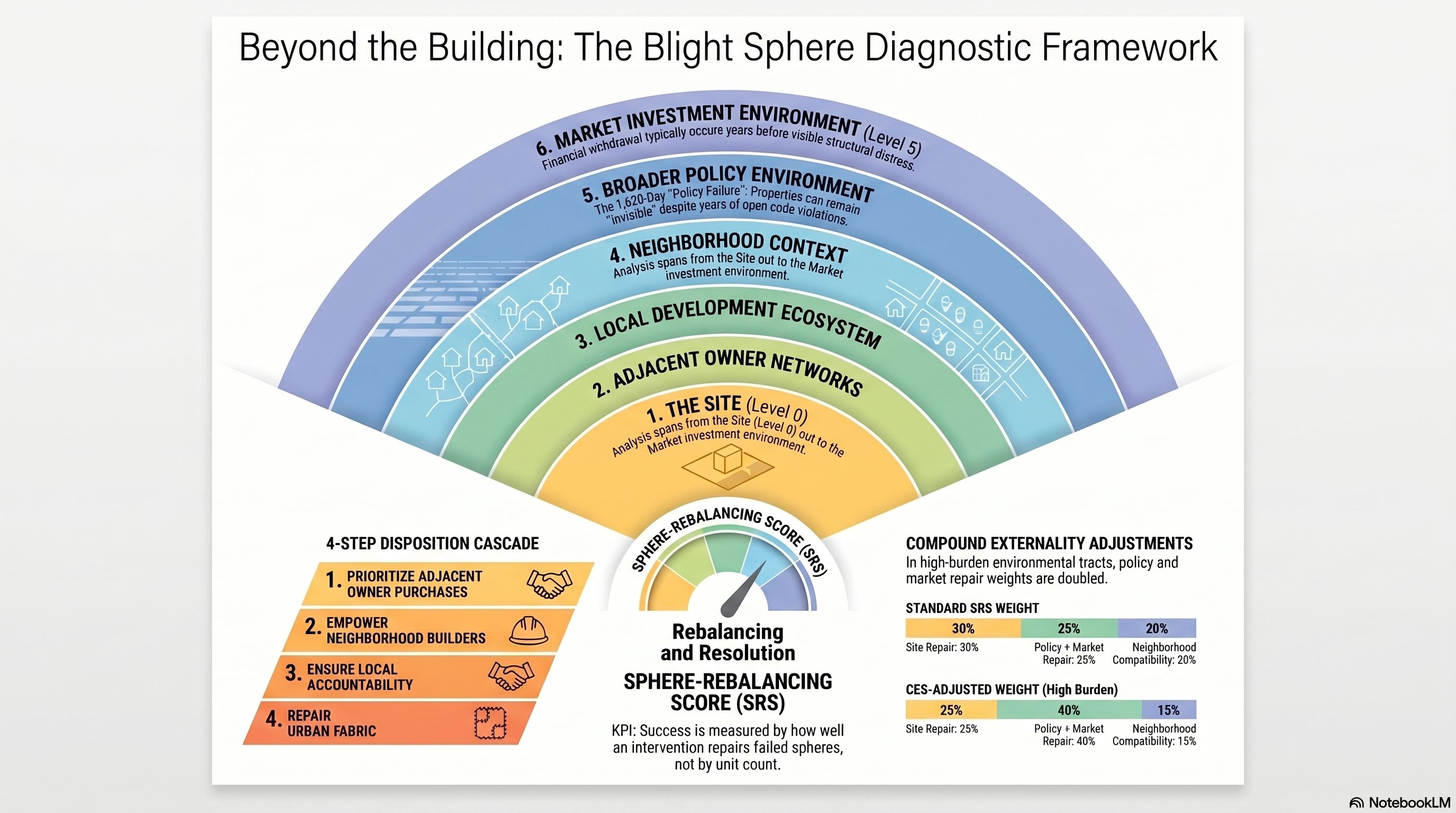
Beyond the building: the blight sphere diagnostic framework.
The presentation package turns the diagnostic into a shareable framework: six concentric failure layers, a four-step disposition cascade, and the sphere-rebalancing score used to judge whether an intervention actually repairs the failed systems around a parcel.
sphere failure map
Three of six spheres are in failure state at the prototype parcel.
investment environment
Zero permit activity since ≥2018. Land appreciation extracted without maintenance obligation. Owner received value uplift; civic goods were never delivered.
regulatory environment
Fine-to-comply cycle ran to closure without physical remediation. 8 cases, 1,620 days open. Property structurally invisible to the active enforcement stream.
service grid and mobility
Metro Bus 78/79 on N Broadway (0.25 mi). No rail within TOC-qualifying radius. Outside Tier 1–2 density bonus territory — base R2/R3 only.
named neighborhood context
No HPOZ on this parcel. HCM-587 (Lincoln Heights Jail) 0.4 mi north — area context, not a design constraint. Setback rhythm: consistent single-family residential.
immediate block fabric
Intact bungalow stock on both sides bearing visual blight, suppressed land value, and structural safety risk as direct externality.
the parcel itself
Blight score 8.42 — extreme distress across all five visual dimensions. End-of-useful-life structure on a ~5,500 SF lot.
sphere failure sequence
Market sphere failed first — years before visible distress was registered.
Each failure loaded the next. Owner withdrawal (2015) meant no investment to arrest deterioration. Policy engagement (2019) reached the fine-to-comply limit without physical effect. Site sphere failure then accumulated without constraint until it registered as extreme visual distress in 2025.
Final recorded investment at the parcel. Market sphere signal: owner withdrawal begins years before any visible distress.
LADBS enforcement engages. Policy sphere activated — remediation still theoretically possible at this stage.
Violations opened, fines issued, cases closed — without physical remediation. Physical conditions unchanged. Cycle repeats.
8 cases, 1,620 days open. Property invisible to the active enforcement stream. Site sphere failure accumulates unimpeded.
Street View confirms extreme distress: vegetation 9 · debris 9 · abandonment 9 · structural 8 · roof 8. Tier 1 candidacy.
six sphere layers — diagnosis inputs
Each sphere has distinct data sources and a distinct failure mode.
- Lot dimensions, legal configuration, zoning
- Structure condition — visual + CSR record
- Utility stub-outs, connection costs, easements
- Ground-lease or community land trust status
Blight score 8.42 — extreme distress across all five visual dimensions. End-of-useful-life structure on a ~5,500 SF lot.
- Adjacent building conditions and use mix
- Alley access, service routes, shared-wall adjacencies
- Daylight and shadow envelopes
- Debris spillover and buffer conditions
Intact bungalow stock on both sides bearing visual blight, suppressed land value, and structural safety risk as direct externality.
- HPOZ boundaries and HCM adjacency
- Street setback rhythm and massing character
- Commercial corridor logic
- Pedestrian network continuity
No HPOZ on this parcel. HCM-587 (Lincoln Heights Jail) 0.4 mi north — area context, not a design constraint. Setback rhythm: consistent single-family residential.
- Metro proximity and TOC tier entitlement
- Bus frequency and stop-level amenity
- Water, sewer, and electrical grid capacity
- Bicycle facility and pedestrian infrastructure
Metro Bus 78/79 on N Broadway (0.25 mi). No rail within TOC-qualifying radius. Outside Tier 1–2 density bonus territory — base R2/R3 only.
- SCEP violation history and CSR timeline
- ED1, TOC eligibility, CEQA exposure
- §17980 substandard building status
- Deed restrictions, rent stabilization covenants
Fine-to-comply cycle ran to closure without physical remediation. 8 cases, 1,620 days open. Property structurally invisible to the active enforcement stream.
- Permit investment activity (5-year trend)
- Ownership churn rate and purchase price history
- Adjacent comparable sales and rent levels
- Land value vs. replacement construction cost
Zero permit activity since ≥2018. Land appreciation extracted without maintenance obligation. Owner received value uplift; civic goods were never delivered.
sphere-rebalancing score
The KPI is not unit count or FAR — it is the degree to which the intervention repairs the failed spheres.
Score dimensions and weights
Resolves physical distress, abandonment, structural safety risk
Reduces externality on adjacent parcels — daylight, value, visual blight
Matches street character, setback rhythm, residential scale
Structurally prevents recurrence — ownership covenant, occupancy obligation
Worked example — 267 S Ave 18, proposed 2-unit + ADU program
Adjacent owner priority purchase · owner-occupant acquisition · alley ADU · residential setback-match at grade.
Full demolition and code-compliant rebuild resolves all five distress conditions.
Setback-matching infill, alley ADU; daylight preserved, visual blight eliminated.
Residential program matches S Avenue 18 single-family setback rhythm.
Proximity freedom cascade applied; no mandatory covenant if adjacent owner purchases at market rate.
disposition cascade — Tier 1 parcels
From eminent domain candidacy to community-priority sale in four steps.
The sphere-rebalancing score determines the design program. The disposition cascade determines who builds it and under what covenant. Both together close the loop between physical repair and market / policy sphere repair.
Final compliance notice with concurrent FMV buyout offer. Owner may self-remedy or exit at market rate. Non-response triggers Step 2.
Adjacent parcel owners offered exclusive window to purchase at FMV. Basis: they are the primary externality victims and hold the strongest claim on remediated land.
Qualified residential builders within the council district offered the site. Residential or mixed-use construction within 18 months required. 10-year affordability covenant on ≥1 unit.
Public bid to any qualified developer. Residential or mixed-use required. No land-banking permitted.
compound externality adjustment
In CES ≥90th-percentile tracts, policy + market repair weight doubles.
Where a blighted parcel sits in a CalEnviroScreen extreme-burden tract, the infrastructure and neighborhood spheres are already under load before the site failure adds its own cost. A design response that resolves only the site sphere leaves the compound failure intact. The SRS adjusts: policy + market repair weight rises from 25% to 40%.
Standard weights
CES < 90th percentile
CES-adjusted weights
CES ≥ 90th percentile
The blight pipeline's invisible-blight findings — zero active CSR records, extreme visual distress, 99th-percentile CES tracts in South LA and East LA — are precisely this class of compound failure: both the policy sphere and the infrastructure sphere have failed simultaneously, and neither failure appears in the city's enforcement data. The CES-adjusted SRS is the appropriate scoring framework for those parcels.
sources